There’s a quote that’s been living rent-free on my LinkedIn profile for years. It’s quite old. I think I first came across it in 2010. Or was it 2012? I honestly can’t remember anymore. Feeling old yet?
What I do remember is that my partner at the time gave me a book called Das Lesikon der visuellen Kommunikation, by Juli Gudehus. I was studying for my B.A. in communication design back then, and the book was pretty much the perfect gift. Gudehus was a real inspiration, because editorial design was one of my passions, and probably still would be if user research hadn’t taken over.

And here was this enormous book, containing thousands of little snippets, definitions, observations and thoughts about visual communication. Almost 3,000 pages, printed on incredibly thin paper that you could nearly see through (also called “Dünndruckpapier” for the typo nerds ❤️).
I loved it. And somewhere in that book, I came across this quote by Alan Fletcher:

It stayed with me. Long enough to end up on my LinkedIn profile, where it’s been sitting ever since. And, recently, I’ve found myself thinking about it again, mostly because of how artificial intelligence is changing the way I work and how I see other people using it.

But to explain why, I need to go back a little.
How I understood it back then

Back then, I didn’t give much thought to what it actually meant to go through a design process, because I was constantly doing it. Researching, planning, sketching, trying something out, realising it didn’t work, changing things, starting again. Sometimes returning to an idea I had discarded hours earlier.
There was a certain structure to it, of course. Design isn’t just a matter of randomly putting things together and hoping something useful comes out of it. The actual experience was much less structured than the explanations we were eventually expected to give. Especially when it came to presenting our work, where suddenly everything needed to make sense, preferably in a logical order.
I remember another quote from that time, by Walter Benjamin:
Das Werk ist die Totenmaske der Konzeption.

The finished work as the death mask of the conception. A rather morbid image, isn’t it? To me, it suggested that the finished work is something that remains after the process that created it has come to an end.
Looking back, I think that’s how I understood Fletcher as well. There was something almost mysterious about the design process. You could describe the steps you had taken, explain your decisions and show the result, but that never seemed to fully capture what had actually happened along the way.
Sixteen years later
Today, I read Fletcher’s quotation a little differently (again 😅). I think he’s talking about the fact how difficult it can be to explain something that you have learned through doing it.
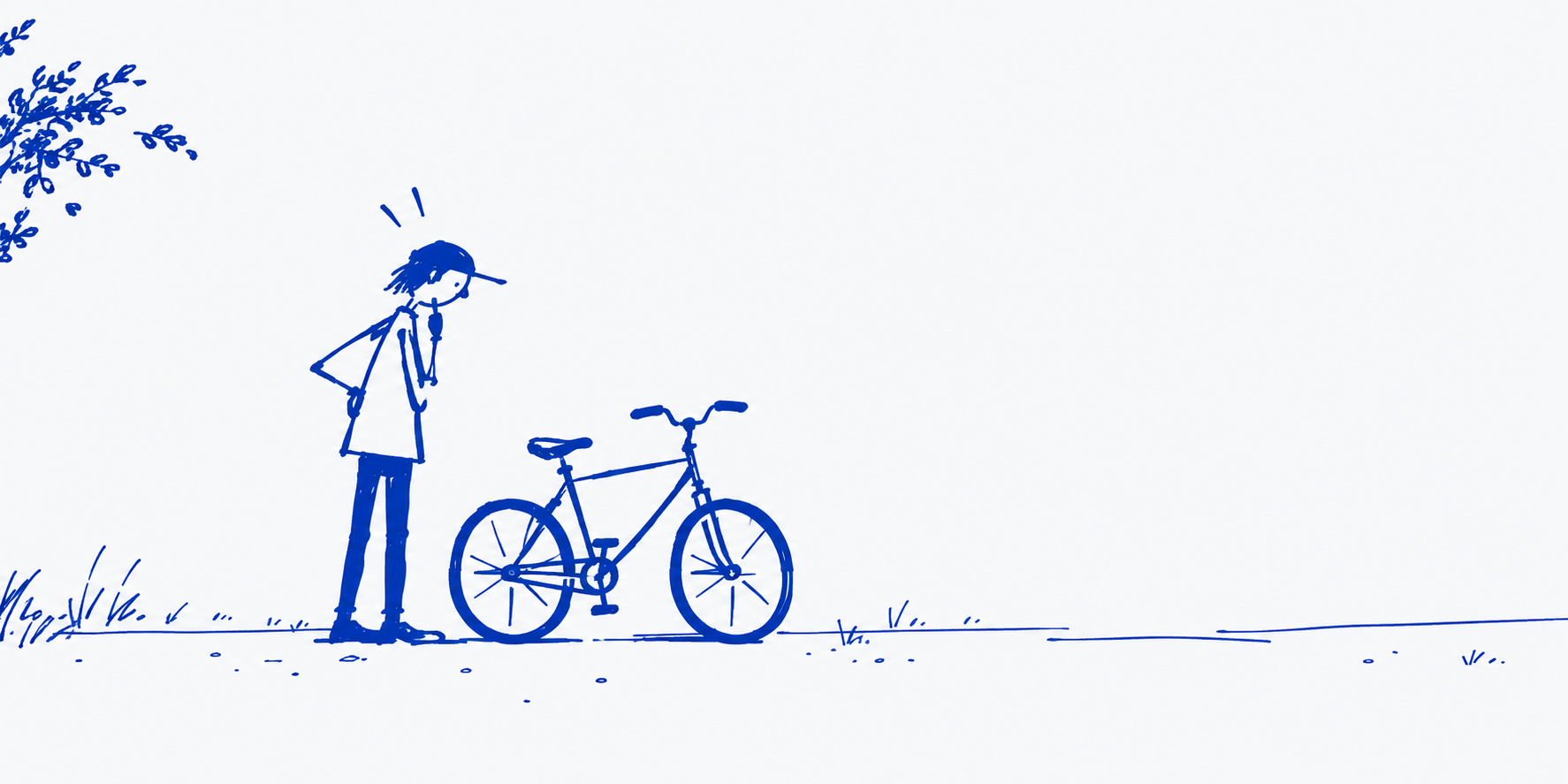
Take his example of riding a bicycle. I could explain how to steer, pedal and maintain balance, even spend an entire afternoon talking about the physics behind it. But would that make you able to ride? Probably not. You’d still have to get on the bicycle, wobble around, probably fall over and gradually develop a feeling for how to stay upright. That’s something you learn by doing, regardless of how well someone explains it to you.
Imagine I describe the process of conducting user interviews. First, we identify the target group, define recruitment criteria, find suitable participants, prepare the interview guide, and finally conduct the interviews. Sounds straightforward, doesn’t it? Now imagine that halfway through an interview, you realise the participant doesn’t actually meet your recruitment criteria as well as you initially thought. Or that your carefully prepared questions aren’t producing particularly useful answers. You have to decide what to do, often right there in the moment. Reading about research methods can prepare you for quite a lot, but actually applying those methods requires experience, especially when things don’t go according to plan.
And please don’t get me wrong. I love theory. I love explaining things, sometimes probably a little too much. One of my colleagues nicknamed me ‘Professor Paul’. 😂 But the difference between knowing a methodology and having the experience to apply it is real. Over time, you develop a certain judgment about what works, what doesn’t, and when you might need to adapt your approach.
What makes this even more interesting is how we describe our work afterwards. Think about the typical design case study. Everything appears wonderfully structured. We identified the problem, conducted research, developed insights, explored possible solutions and eventually arrived at the final design. Nice. Except that’s usually not how it happened.
Sometimes I feel the actual design process is a second-hand suit, held together with safety pins at the back, while everyone gets to admire the perfectly tailored front. The presentation might make sense. It might even be an accurate summary of the most important decisions. But it leaves out so much of the uncertainty, experimentation and occasional confusion that was part of getting there.
And maybe that’s what Fletcher was getting at. We can explain the process, but the explanation cannot fully reproduce the experience.
Getting to the result without getting there
Now, what happens when we introduce AI into this?
I was involved in a project exploring an AI-powered chatbot. We had limited time for research, some colleagues were unavailable, and I needed to get a better understanding of existing chatbot experiences and usability principles. So I used AI to explore existing research, including work from Nielsen Norman Group, and develop ideas for an initial user journey.
And it actually worked rather well. I could build on research that already existed without spending days collecting and organising everything myself. It also helped me make the team aware of common usability pitfalls before we’d even implemented the chatbot. Take something as seemingly trivial as the placement of the chat icon. Why put it somewhere unexpected when people are already accustomed to finding it in the bottom-right corner? 😉 These are the kinds of things others have already investigated, so I didn’t have to start from scratch.
But afterwards, I wondered whether I would have reached the same conclusions if I had gone through the research process on my own. Would I have noticed something different? Would I have approached the problem from another angle? Perhaps I would have spent hours researching something that AI helped me understand in minutes.
Even though I saved time initially, I still had to make sense of the information and consider how it applied to the project. But I couldn’t really compare that experience with the one I would have had without AI, because that alternative process never happened.
Fletcher describes the difficulty of explaining a process that someone has experienced. With AI, we’re introducing another possibility: we might be able to produce a convincing result without having experienced much of the process ourselves. And I wonder what that means for the development of our own skills and judgment.
But haven’t we always used tools to make things easier?
During my M.Sc. in interdisciplinary media studies we spent quite a bit of time discussing how technolgoies change the way we work and the skills we need. AI certainly isn’t the first tool to do that.
I remember reading Jochen Hörisch’s Eine Geschichte der Medien1 and discussing ideas about how technologies extend our human capabilities. Marshall McLuhan, for example, described media as extensions of ourselves2. The wheel extends our ability to move, while other technologies extend different physical and cognitive capacities. Think about the sewing machine or the washing machine. Both dramatically changed activities that previously required more manual labour. And yet, using new technologies often requires us to develop new skills.
Perhaps AI isn’t fundamentally different, at least in principle. Like these earlier technologies, it helps us do certain things more efficiently. Some activities are repetitive, time-consuming and add little to our understanding. If AI helps us get those things done faster, why wouldn’t we use it?
Still, I keep returning to the question of which parts of the process we can safely leave to a tool.
Take a researcher who uses AI to help identify relevant literature, checks the original sources and then spends the remaining time investigating the actual problem. I can imagine that person developing a very good understanding of the subject, perhaps even better than someone who spent days manually collecting articles.
Now imagine someone who asks AI for a research plan, receives a convincing result and simply follows it. The plan might actually work. It might even produce useful findings. But would that person be able to explain why the suggested methodology was appropriate, or recognise when it needed to be changed?

I think you notice the difference when the plan stops working. It’s one thing to follow a methodology when everything goes as expected. But what happens when you realise, halfway through, that you need to change it? And frustrating as those moments can be, they’re often where you actually learn.
What bothers me is that we often talk about optimising processes without really discussing which parts of those processes contribute to our expertise. And the inconvenient problem is that we might need a certain amount of experience before we’re even capable of recognising which parts are worth experiencing.
Just give me the answer
But there’s another side to this. Even when we do go through the process ourselves, how much of that experience actually reaches the people who rely on our conclusions? In corporate environments, people often want answers preferably quickly, in a format that doesn’t require too much time to read. I remember explaining some research-related context to a colleague and receiving a rather familiar response: “TL;DR.” Too long; didn’t read.
And I get it. People are busy. Nobody has unlimited time to read research reports, investigate every methodological decision or discuss every finding in detail. That’s why we write summaries in the first place. But I wonder whether we’re becoming so focused on the final recommendation that the reasoning behind it is treated as something optional.
Imagine presenting research findings to a stakeholder who primarily wants to know what should be done next. A recommendation might be perfectly reasonable, but its usefulness depends on the circumstances in which the research was conducted. Once those details are condensed into a few bullet points, it becomes harder to tell when the recommendation applies. I don’t expect stakeholders to understand every methodological detail, but I think it’s my responsibility to provide enough context to recognise its limitations.
In my work, there’s already pressure to provide answers quickly. AI can now produce a convincing recommendation in seconds, sometimes without making it clear which evidence supports it or how well that evidence applies to the problem. I suspect this makes it easier to accept an answer before anyone has examined it closely enough.
An uncomfortable little contradiction
There’s something else I should probably mention. While developing this very article, I used AI to help me revisit Fletcher’s quotation. I wanted to explore how I understood it today and whether my interpretation had changed since I first encountered it. The AI gave me examples, explanations and connections to my work in UX research, some of which eventually made their way into an early draft.
And at some point, I noticed the rather obvious contradiction. Here I was, writing an article about how AI might allow us to skip parts of the thinking process, while using AI to help me develop the article itself.
Well done, Paul. 😂

But what happened afterwards was more interesting. I started questioning some of the examples AI had given me. I remembered ideas from my media studies, connected them to experiences I’d had at work, and began reconsidering what I was actually trying to say.
Was I skipping parts of the process? Probably. But I was also spending time questioning ideas, discarding suggestions and reconsidering my own arguments. That’s a process in itself, isn’t it? Whether I would have arrived at the same thoughts without AI, I can’t really know. And perhaps that’s something I simply have to accept.
That also brings me back to Fletcher.
When I talk about the design process, I’m thinking about the experience of trying to understand something, making decisions, occasionally getting things wrong and learning along the way. Some of that effort is probably unnecessary. But I suspect other parts contribute to our judgment in ways we don’t always recognise at the time.
If I know how to ride a bicycle, I might struggle to explain exactly how I maintain my balance. Nevertheless, I have developed that ability through experience. Now imagine having a technology that could take me wherever I wanted to go without ever needing to learn how to ride. Would I still need to learn? Depending on what I wanted to achieve, perhaps not. But I wonder whether I would recognise what I was missing.
I don’t have a straightforward answer yet. I use AI regularly, and I can think of many situations where it has helped me quite a lot. I don’t necessarily want to return to spending hours on activities that technology can handle more efficiently.
If someone asks me how I arrived at a specific result, “I used AI” tells them which tool was involved. It doesn’t tell them much about what I understood, why I made certain decisions or whether I could recognise a problem with the result. And I think I’d like to know when I’m genuinely making those decisions myself, and when I’m simply accepting something because it seems reasonable.
So, how much of the process did I actually understand, and how much did I simply skip?
That makes me think about people who are only just starting out in research. Maybe they’ll develop their judgment differently from how I developed mine. But if AI helps them skip the very experiences that taught me when to question a result, how will they learn when to question what AI gives them?

Footnotes
- Hörisch traces the history of media through the relationship between Sinn (meaning) and Sinne (the senses). He argues that earlier media, particularly speech and writing, were primarily oriented towards meaning, while modern audiovisual technologies increasingly engage our senses. See Jochen Hörisch, Der Sinn und die Sinne: Eine Geschichte der Medien (2001), later published as Eine Geschichte der Medien: Von der Oblate zum Internet (Suhrkamp, 2004), especially the introduction.
↩︎ - For Marshall McLuhan, technologies extend human capabilities. The wheel extends our ability to move, while electronic media extend our senses and capacity to communicate. These extensions also change how we experience and interact with the world. For more, see his book Understanding Media: The Extensions of Man (1964), here Chapter 1, “The Medium Is the Message,” and Chapter 19, “Wheel, Bicycle, and Airplane.”
A little anecdote: His later book with Quentin Fiore, The Medium Is the Massage (1967), got its title from a typesetting error. McLuhan apparently liked the mistake so much that he decided to keep it. ↩︎
Leave a Reply