Bachelor’s thesis · B.A. Design (Communication Design) · Hochschule Niederrhein · 2012 · Thesis grade: 1.0
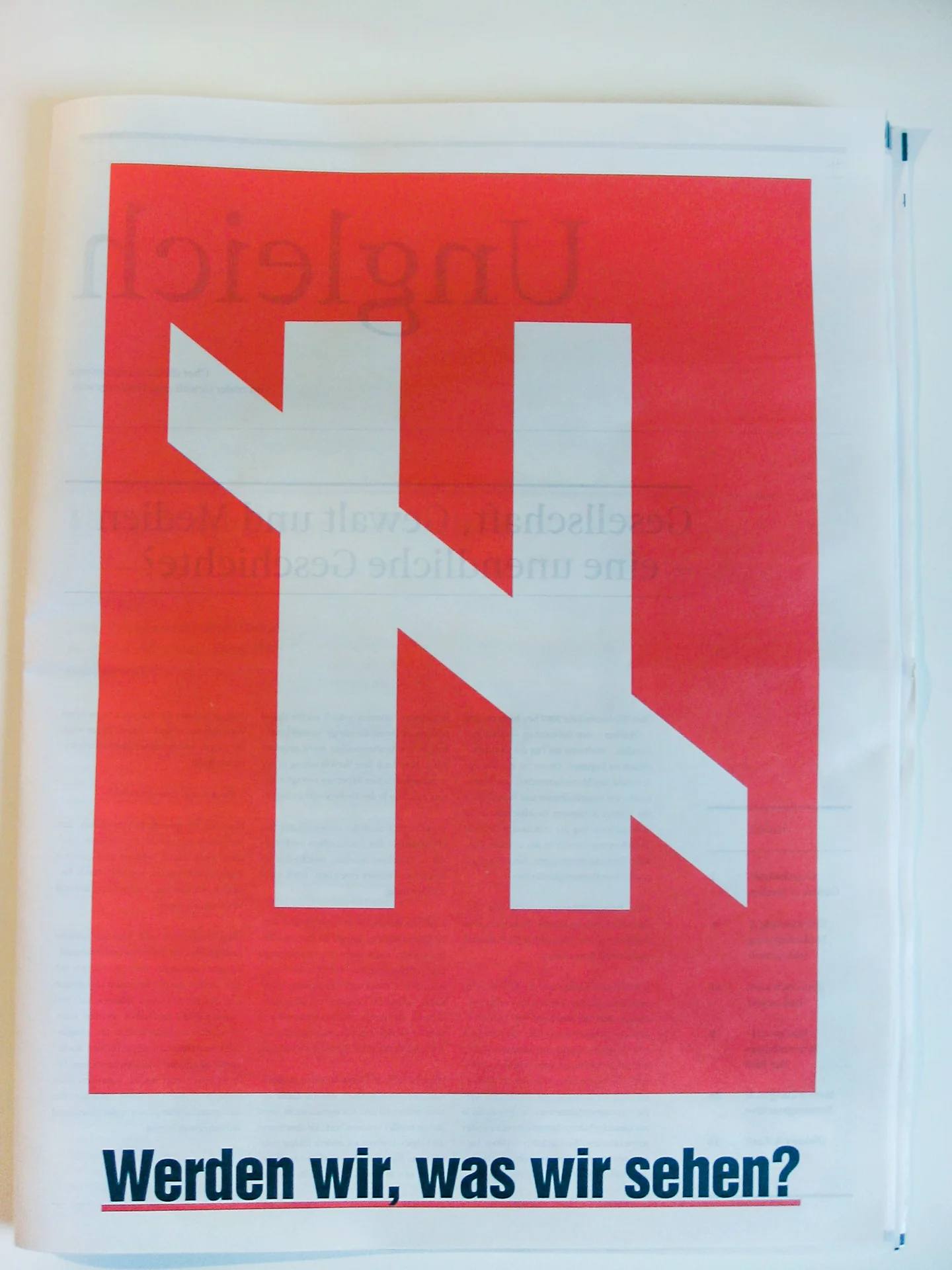
For my bachelor’s thesis, I explored how media select and present violence, and how editorial design could help readers question what they see. Developed as a student concept for a special supplement to the Frankfurter Allgemeine Zeitung, Ungleich translated a written research thesis into a newspaper and an accompanying video.
I wanted to use the tabloid press’s own methods to question how it attracts attention. Cynicism and irony were central to the idea: draw readers in, then give them a reason to examine the presentation itself.
One newspaper, two visual styles
The newspaper was the main output. I chose the format for the space it offered to combine visual explanations with a detailed account of the research. Within a single publication, I brought together two contrasting visual styles. The first section took its cues from the Frankfurter Allgemeine Zeitung, using a restrained layout to present research on violence and media.
The second section used BILD-inspired typography and visual emphasis to present scientific content. That contradiction was deliberate. I wanted the tabloid presentation to draw readers in, then make them question how it directed their attention and shaped their expectations.


What the research led me to
The written thesis examined how media select and present violence, how audiences respond to it, and how scientific findings enter public debate. I drew on studies of aggression,1 media effects2 and how audiences interpret violent content,3 alongside research into BILD’s editorial practices.4 Three conclusions shaped the project.
Media can warn about violence while using it to attract attention. In the thesis, I argued that some media outlets warn audiences about the dangers of violent content while also using its fascination to attract attention. This tension became a starting point for the newspaper’s critical use of tabloid presentation.
Research and public debate follow different rules. Scientific findings depend on definitions, methods and context. News coverage can leave out those limits and conditions, turning a complex finding into a simple explanation or a striking claim.5 The challenge was to make research accessible while retaining the distinctions that give it meaning.
Design can help research reach a wider audience. I concluded that communication designers could work with researchers to explain their findings beyond specialist publications, without losing important context. That became the purpose of the newspaper.
Designing for a closer look
For me, the design question was how to catch someone’s attention and then give them a reason to look more closely. The newspaper offered room for detailed explanations; the video was intended to bring people towards them. Editorial design became part of how I explored that question.
The video
Alongside the newspaper, I made the German-language video Werden wir was wir lesen und sehen?—“Do we become what we read and see?” In the written thesis, I described it as an attention-grabbing entry point on a dedicated website, intended to reach people beyond the newspaper and direct them towards the research.
Watch the original project video on YouTube (German).
More from the publication
Select an image to enlarge it.


Thesis examiners: Prof. Nora Gummert Hauser (first examiner) and Reinhold Scheer (second examiner).
This article describes the project and its research context at the time of the thesis.
References
- Wahl, Klaus (2009). Aggression und Gewalt: Ein biologischer, psychologischer und sozialwissenschaftlicher Überblick. Spektrum Akademischer Verlag. Publisher’s page (DOI) ↩︎
- Kunczik, Michael, and Astrid Zipfel (2006). Gewalt und Medien: Ein Studienhandbuch. 5th, fully revised edition. Böhlau. ↩︎
- Meister, Dorothee M., Uwe Sander, Klaus Peter Treumann, Eckhard Burkatzki, Jörg Hagedorn, Mareike Strotmann, and Claudia Wegener (2008). Mediale Gewalt: Ihre Rezeption, Wahrnehmung und Bewertung durch Jugendliche. VS Verlag für Sozialwissenschaften. Publisher’s page (DOI) ↩︎
- Arlt, Hans-Jürgen, and Wolfgang Storz (2011). Drucksache “Bild”: Eine Marke und ihre Mägde. Die “Bild”-Darstellung der Griechenland- und Eurokrise 2010. OBS-Arbeitsheft 67. Otto Brenner Stiftung. Read the study (PDF) ↩︎
- Brosius, Hans-Bernd, and Katja Schwer (2008). Die Forschung über Mediengewalt: Deutungshoheit von Kommunikationswissenschaft, Medienpsychologie oder Medienpädagogik? Nomos. ISBN 978-3-8329-3371-5. Publisher’s page ↩︎
Leave a Reply