I usually talk about how User Experience Insights drive success for customer satisfaction and business. But let’s look to another impact—the absence of UX research. What happens when cutting UX and UX research?
Imagine a scenario that’s becoming all too common. With economic pressure, companies are reducing IT budgets. UX positions are still often among the first to go. When organisations decide to reduce their investment in UX, they often underestimate the ripple effects that follow.
It feels like being Scully in The X-Files (who is old enough remember this awesome TV series?) when someone says, “We need to cut position X to improve metric Y.” Then I want to ask, “What data supports this decision?” Where’s the data, Mulder? Because let’s be real—the dissatisfaction is out there!
A common believe behind these cuts is that reducing resources—especially UX professionals—will save money. Developers and technical roles are often seen as critical for a product’s survival, while UX is treated as less essential.
Common Misconceptions about UX and cost reduction
Misconception 1:
“Reducing UX staff saves costs without affecting customer retention or satisfaction.”
Counterpoint: The absence of UX increases technical debt and frustrates customers. It also escalates operational costs, all of which probably outweigh immediate savings.
Data: A study by Forester Research (2020) found that poor UX caused 50% of customer churn in digital products. It highlighted the hidden costs of neglecting user-centered design. I will explore this counterpoint more below.
Misconception 2:
“Engineering roles are critical, but UX can be deprioritised without significant impact.”
Counterpoint: Engineers build solutions, but UX ensures that those align with user needs. Ignoring UX risks even in maintenance creates misaligned products that users find cumbersome and abandon entirely.
Data: In 2019, a global airline redesigned its online booking system but skipped usability testing. The outcome was a 25% increase in customer complaints. There was also a 15% drop in bookings within three months. This information comes from a case study published by Nielsen Norman Group (NNG).
Misconception 3:
“We’ll notice if user satisfaction drops and can course-correct then…”
Counterpoint: UX issues often show up gradually, making it hard to pinpoint their cause. By the time measurable damage—like lower CSAT scores and higher churn rates—becomes obvious, recovery is more expensive and challenging.
Data: Microsoft infamous “Clippy” assistant is a good example. The lack of user research during its development led to widespread frustration, requiring significant redesign efforts to fix negative perceptions (Microsoft UX archives, 2007)
The Timeline of UX Impact
Companies assume that UX cuts won’t have immediate effects—thinking customers will keep buying anyway. But ignoring user satisfaction isn’t about if it will backfire, but when and how severe.
Here’s a timeline of expected stages of decline after UX resources are reduced.

Short-Term Impact (3–6 months):
- Delayed Feedback Loops: User insights from interviews, surveys, and satisfaction metrics (e.g., CSAT, NPS) take longer to reach product teams, as no UX professional manages them anymore.
- Without UX professionals, product teams start to struggle to adapt and addressing changes in customer needs.
Click here to explore the data about this time period
- Amazon (2021) found that shortening UX feedback loops by 30% resulted in a 20% increase in user satisfaction within six months.
- Research by Watermark Consulting shows that CX leaders outperform competitors significantly in revenue and stock performance (Watermark Consulting 2021).
Mid-Term Impact (6–12 months):
- Accumulation of Usability Issues: The world keeps moving. Real-life usage of products & processes constantly produce new usability problems, and these issues pile up as unresolved technical debt.
- Rising Costs: Declining CSAT and NPS scores show more customer complaints and show rising support costs.
- Loss of Engagement: Interaction with users decreases without a dedicated UX person in product teams to highlight user needs. As a result, teams often focus solely on technical business objectives. This might not lead to better usability or user experience.
- Bounce and abandonment rates increase, especially for customer-facing products, leading to reduced user engagement.
Click here to explore the data about this time period
- Example: IBM’s research (2020) showed that unresolved usability flaws can increase development costs by 50% due to rework.
- Poor UX leads to higher churn rates for B2B software. Churn increases by 15–20% where usability issues hinder productivity (Watermark Consulting, 2022).
- Evidence: Zendesk (2021) reported that companies with poor UX experience produce more support tickets. They see a 40% surge in support tickets within a year after cutting UX resources.
Long-Term Impact (12–18 months and beyond):
- Customer churn increases noticeably, impacting retention and revenue.
- Reputation damage becomes obvious as dissatisfied customers share negative experiences.
- Market loss: Competitors take advantage by offering more seamless and user-focused alternatives.
Click here to explore the data about this time period
- Example: A B2B SaaS company was featured in a Gartner study (2022). It experienced a 20% revenue decline due to poor UX-driven churn.
Why UX is Business-Critical
The points below are probably known, but I will add them anyways, for the chill…
1. Customer Satisfaction and Retention
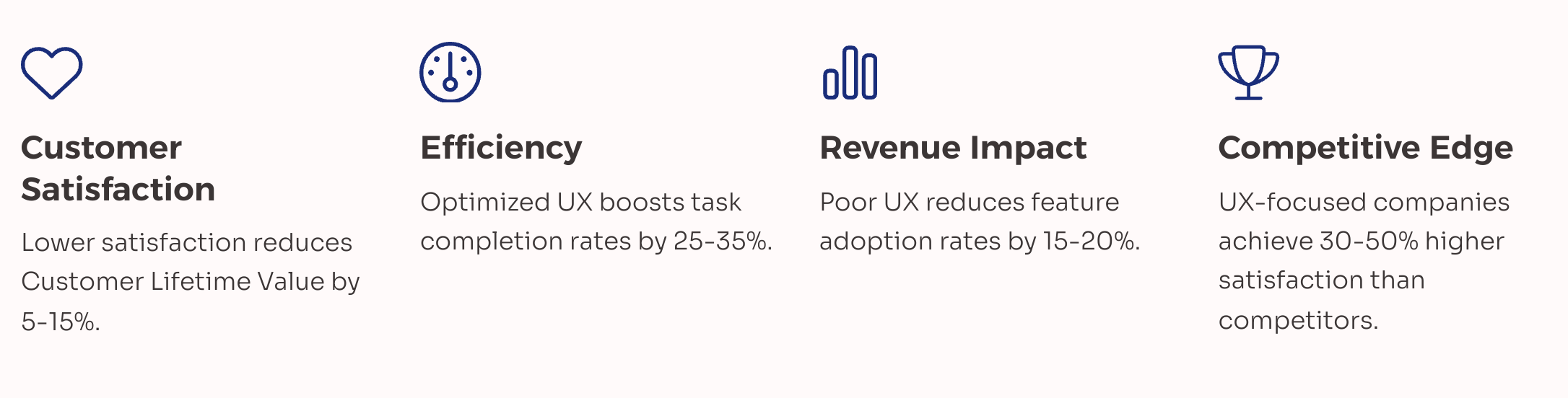
- Lower Satisfaction = Lower Profitability: Sustained dissatisfaction reduces Customer Lifetime Value by 5–15% (Forrester Research, 2023).
- Cost of Churn: Retaining customers is 5–25x cheaper than acquiring new ones. Poor UX increases churn, especially in B2B contexts.
- NPS Decline: Pain points reduce NPS by 10–30% within a year, triggering churn and lost referrals (Gartner, 2021).
2. Efficiency and Productivity
- Task Efficiency: The Nielsen Norman Group (2020) reported that optimised UX boosts task completion rates by 25–35%. It cuts frustration and reduces support costs.
- Support Costs: Poor UX drives 20–40% higher support tickets, increasing operational costs (NNG, 2020).
- Role Disruption: UX roles often come with deep organisational knowledge and integration. Removing these positions from product teams disrupts workflows in ways that are much harder to recover from compared to other modular roles like engineering.
3. Conversion and Revenue Impact
- Adoption Rates: Poor UX reduces feature adoption rates by 15–20% (Adobe Digital Trends, 2022). E. g. a European e-commerce retailer improved revenue by 35% after implementing usability testing (ebd., 2022).
- Revenue Losses: Customer Lifetime Value drops by 5–15% due to dissatisfaction. This usually leads to lower renewals and upsell opportunities (Gartner, 2021).
4. Brand Perception and Competitive Edge
- Reputation Damage: Dissatisfied customers, especially in B2B, share negative experiences widely within professional networks. This behaviour damages trust. It also turns off prospect customers.
- Market Position: Companies prioritising UX achieve 30–50% higher satisfaction than competitors, giving them a clear advantage (Watermark Consulting, 2021).
Why Cutting UX is Risky
For B2B customer-facing products, dissatisfaction doesn’t just reduce retention—it increases costs:

- Higher Acquisition Costs: Dissatisfied users churn, forcing companies to invest in costly acquisition strategies. Sales Force costs… anyone?
- Operational Inefficiencies: Poor usability and UX lead to more support tickets. It creates “technical debt” that reduces productivity. This increases costs due to costly rework. Boom 🤯
Further risks include:
- Brand Perception: Lingering UX issues impact the trust and professionalism in the eyes of customers.
- Competitive Positioning: Competitors who prioritise UX will use their advantage on dissatisfied users, gaining market share.
- Shareholder Concerns: Cutting UX may appear shortsighted, which could alarm investors focused on long-term sustainability.
Addressing Cost Pressures Without Sacrificing UX, but how?
Cost-cutting doesn’t have to mean abandoning UX. Companies can take strategic measures to preserve its value:
- Quantifying UX Contributions: I get it. Decision makers who cut UX positions often are not the ones using the products that rely on UX. I also know that many of our UX folks could do better in communication in general. Thus use data-driven case studies to advocate for the business-critical nature of UX (e.g., ROI from usability improvements). This is especially important before potential UX cuts happen. It shows the number of usability issues and improvements. It also highlights their implications.
- Streamlining Research Workflows: Focus on high-impact research and scalable methods, like moderated usability tests and surveys. Use a UX research repository that enables asynchronous research and analysis efforts to centralise and reuse insights across teams.
- Prioritise Key Roles: Keep key UX positions to react to market and customer needs effectively, instead of reducing all. Integrate UX into cross-functional teams to maximize efficiency and visibility.
The Real Value of UX: A Data-Driven Perspective
Companies cutting UX might think they’re solving short-term budget issues. But, the data tells a different story. UX professionals don’t just improve customer processes—they safeguard customer satisfaction, retention, and revenue.
By treating UX as non-essential, companies risk alienating customers, damaging their brand, and losing competitive advantage. The long-term costs—churn, inefficiency, and lost market share—far outweigh any immediate savings.
In the words of Mulder from The X-Files:
“The truth is out there.”
The value of UX is not a conspiracy theory; it’s real. It’s written in retention curves, churn rates, and satisfaction scores. I dearly dearly believe that companies embracing their dependency on good UX will thrive. Those that don’t? They risk fading into the unknown.
Disclaimer
The text in this article was improved with help of WordPress AI and ChatGPT. The pictures were created using Microsoft Designer and Gamma.


 Paul Pagel, M.Sc.